Welcome to VMA Psych.
Your trusted provider of exceptional mental health services in the GTA & beyond. Learn More
With 40+ years as Toronto's leading psychologists, we guide individuals through life's complexities, offering specialized services for a brighter future.
Recommended For You


Quick Answer
The best books for overcoming social anxiety combine evidence-based approaches, like Cognitive Behavioural Therapy (CBT), Exposure Therapy, and Acceptance and Commitment Therapy (ACT), with real compassion for how exhausting the condition actually feels. How to Be Yourself by Dr. Ellen Hendriksen is our top overall pick, though the right book for you depends on whether you want structured exercises, a compassion-based approach, or a more conversational read.
The Clinical Insight: Social anxiety is tied to how your brain's threat-detection system responds to perceived social risk, not a character flaw.
The Takeaway: CBT and Exposure Therapy are the clinical gold standards, with books built around CBT or ACT serving as a well-matched supplement between sessions.
Getting Support: VMA Psych offers therapy for social anxiety in Etobicoke, in person and virtually, across Toronto, the GTA, and Ontario.
You're Not Just "Shy"
Social anxiety gets minimized a lot, often written off as "just shyness." For the people actually living with it, it's far more distressing and exhausting than that label suggests. Clinically, it involves a persistent, intense fear of being judged, negatively evaluated, or rejected in social or performance situations, often leading to avoidance, heightened self-consciousness, and real interference with daily life.
If walking into a crowded room, speaking up in a meeting, or even making a phone call sends your nervous system into a spiral, you're far from alone. Social Anxiety Disorder (SAD) is one of the most common mental health conditions in the world.
At VMA Psych, we help clients across Etobicoke and the GTA work through exactly this. Below, we explain the neuroscience behind why social anxiety feels so physical, then share our picks for the 15 best books to support your recovery.
The Neurobiology of Social Anxiety: Why It Feels So Physical
To work through social anxiety, it helps to understand that it's a physiological event first, not just a psychological one. You can't simply think positively when your brain believes you're genuinely in danger.
When you walk into a triggering social situation, your amygdala, the brain's threat-detection centre, mistakes social evaluation for a physical threat. It hijacks the brain and suppresses your prefrontal cortex, the part responsible for logic and rational thought.
When your sympathetic nervous system kicks into fight, flight, freeze, or fawn, flooding your body with adrenaline and cortisol, which is exactly why social anxiety comes with such strong physical symptoms:
Sweating and blushing: Blood vessels dilate, preparing the body to flee
A racing heart: Pumping hard to get oxygen to your muscles
A "blank" mind: With the prefrontal cortex suppressed, working memory briefly shuts down, which is why you can forget what you meant to say mid-sentence
The spotlight effect
From a cognitive angle, social anxiety is heavily driven by what psychologists call the spotlight effect, a distortion where your brain overestimates how much other people are actually noticing or judging you. Understanding both the biological and cognitive sides of social anxiety is the real first step toward rewiring your brain for more social confidence.
So, What Are the Best Books for Overcoming Social Anxiety?
Clinical research consistently shows that CBT and Exposure Therapy are the gold-standard treatments for social anxiety. Reading, a practice clinicians call bibliotherapy, is a well-supported supplement to that work. It normalizes what you're going through, builds your psychoeducation, and gives you coping tools to practise between sessions. Here are our picks for the 15 best, most clinically grounded books on CBT, ACT, and Compassion-Focused Therapy.
CBT-Based Approaches
How to Be Yourself by Ellen Hendriksen, PhD

VMA Psych's top recommendation. If you only read one book on this list, make it this one. Dr. Hendriksen blends solid neuroscience with real compassion to explain why our brains freeze up socially, written specifically for introverts and people with social anxiety. Rather than pushing you to fake extroversion, she reframes social anxiety as a learned pattern rather than a personality flaw, and teaches you to quiet your inner critic instead of trying to become someone else entirely. The core message is deeply reassuring: you already have what you need to navigate social situations, and gently practising exposure while gradually dropping your safety behaviours will get you there.
What sets this one apart is how specific it gets about identifying your own personal safety behaviours, the small habits like over-rehearsing what you're going to say, avoiding eye contact, or staying near the exit, that feel protective but actually keep the anxiety loop running. It includes real scripts and language for common trigger moments, like introductions and small talk, making it less abstract than many anxiety books. It's the best starting point if you've been told to just be more outgoing and want something that first validates your experience, rather than a strict, workbook-style program.
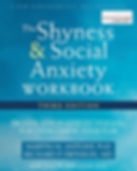
The Shyness and Social Anxiety Workbook by Martin M. Antony, PhD, and Richard P. Swinson, MD
A foundational staple of clinical psychology, this is the pick for anyone who wants a structured, roll-up-your-sleeves CBT approach. It walks readers through identifying specific cognitive distortions, such as mind-reading and fortune-telling, that fuel social dread, then moves into daily, actionable exercises. Its standout feature is a step-by-step framework for building exposure hierarchies, so you confront your fears in manageable, graduated stages rather than all at once.
The workbook format is the real draw here. It includes printable-style worksheets for logging anxious predictions, rating anxiety before and after each exposure, and tracking progress numerically over weeks. It's built more like a multi-week program than a single read-through, making it the best fit for people who like homework, measurable progress, and a clear sequence to follow.
Overcoming Social Anxiety and Shyness by Gillian Butler, PhD

Dr. Butler offers an accessible, hands-on CBT-based guide focused squarely on the self-consciousness at the centre of social anxiety, including a close look at the spotlight effect described above. She explains how social anxiety turns your attention painfully inward, then gives practical tools for redirecting attention outward and testing the catastrophic predictions anxiety generates.
Butler leans heavily on what CBT calls behavioural experiments: small, structured tests in which you predict what will happen in a social situation, try it, and compare the outcome to your prediction. This appeals to a more analytical reader who wants to treat anxious beliefs like hypotheses to test rather than facts to accept, making it a good complement to the Antony and Swinson workbook above.
ACT and Compassion-Focused Approaches
The Mindfulness and Acceptance Workbook for Social Anxiety and Shyness by Jan E. Fleming, MD, and Nancy L. Kocovski, PhD
This one moves past traditional CBT into Acceptance and Commitment Therapy. Instead of fighting or eliminating anxious thoughts, it teaches you to change your relationship with them through mindfulness and cognitive defusion, recognizing anxious thoughts as passing mental events rather than commands you have to obey. The core takeaway is freeing: you don't need to eliminate anxiety to live a full life.
Practically, the book leans on guided mindfulness exercises and simple defusion techniques, like mentally labelling a thought as "I'm noticing the thought that..." rather than treating it as fact. It's the strongest pick on this list for anyone who has already tried a more traditional CBT approach and found themselves exhausted from constantly arguing with their own anxious thoughts, since ACT offers a distinctly different relationship to the anxiety itself.

The Compassionate-Mind Guide to Building Social Confidence by Mary Welford, PhD

Because social anxiety is so tangled up with shame and self-criticism, purely logic-based approaches sometimes fall short, which is where Compassion-Focused Therapy comes in. Dr. Welford explores the evolutionary psychology behind our need for social belonging and why rejection can trigger such an intense, physical sense of danger.
Exercises include guided imagery and visualization work aimed at building an internal compassionate self you can call on in triggering moments, a different toolkit than the thought-challenging worksheets found in more traditional CBT books. This is the strongest pick on this list for readers whose social anxiety is bound up with perfectionism, harsh self-talk, or a difficult early home environment.
More Specialized Angles
We're All Mad Here by Claire Eastham
For readers who find clinical workbooks a bit dry, this is the more conversational alternative. Eastham blends candid personal stories with practical, manageable advice, and does a lot to strip away the shame that often surrounds this condition. The real strength here is validation: she reminds readers that their anxiety-driven thoughts and behaviours are far more common than they feel.
The book is organized around specific, relatable everyday scenarios, parties, dating, and the workplace, rather than abstract theory, making it easy to jump straight to whatever situation is stressing you out most. It's short enough to read in a single sitting, a good fit for someone newly grappling with a diagnosis who wants to feel less alone before diving into a more structured program.

Chatter by Ethan Kross, PhD

Not a social anxiety book specifically, but a remarkably useful one for understanding the inner critic that drives it. Dr. Kross digs into why our internal monologue turns negative and catastrophic in social situations, and why we replay awkward moments long after they've passed. One especially practical tool from the book is distanced self-talk, using your own name or third-person pronouns when you talk to yourself, which measurably reduces emotional reactivity in the moment.
Beyond self-talk, Kross also covers less obvious tools, such as how your physical environment, rituals, and even brief exposure to nature can quiet a spiralling inner monologue. Because it's grounded in broader psychological research rather than social anxiety specifically, it's the best fit for readers, especially professionals, whose anxious chatter bleeds into decision-making and rumination well beyond social situations.
The Solution to Social Anxiety by Aziz Gazipura, PsyD
Dr. Gazipura writes from personal experience with severe shyness, and it shows in how actionable and empathetic this book feels. He specifically challenges chronic people-pleasing and conflict avoidance, the patterns many anxious people use as a shield against judgment. The standout idea here is that confidence follows action, not the other way around.
The book includes direct, structured exercises for practising small acts of assertiveness, like voicing a mild disagreement or making a request, treated almost like reps in a workout program that get easier with repetition. It's a particularly good fit for people-pleasers who recognize they avoid conflict, specifically at work or in relationships.

Dare by Barry McDonagh

If panic attacks show up alongside your social anxiety, this book offers a notably counterintuitive approach. Rather than teaching you to calm down, which can subtly signal to your brain that there's something to fear, McDonagh teaches you to lean directly into the physical sensations of anxiety using a four-step method: defuse, allow, run toward, engage. The core idea is paradoxical intention: by daring your anxiety to do its worst instead of resisting it, the panic loop tends to break.
This one is built for in-the-moment use rather than long-term insight, with short, scriptable phrases you can mentally reach for the instant panic starts to spike. It's the best pick specifically for readers who've tried standard breathing or grounding techniques and found that focusing on calming down actually made their panic worse.
Daily Habits and Targeted Situations
Thriving with Social Anxiety by Hattie C. Cooper
This guide focuses less on major events like public speaking and more on the low-grade, exhausting dread that colours daily life for many people with social anxiety. It's built around sustainable daily habits and nervous-system-supporting routines rather than one-off interventions.
The structure follows a day-by-day format, with morning and evening reflection prompts rather than chapters organized around single concepts. That makes it a strong match for readers who respond well to habit trackers and daily check-ins.

Stop Anxiety from Stopping You by Helen Odessky, PsyD

Dr. Odessky offers a clear, practical six-step framework aimed at keeping anxiety from derailing your career and daily life, without leaning too hard on clinical jargon. She's especially strong on high-stakes, specific fears like speaking up in meetings or navigating networking events.
Where this book stands out is its workplace-specific focus: it walks through real scenarios such as presentations, performance reviews, and networking events, with tailored scripts and preparation strategies for each. If your social anxiety mostly flares up in professional settings, this is a more targeted choice than the more general workbooks earlier on this list.
Living Fully with Shyness and Social Anxiety by Erika Hilliard
This comprehensive guide stands out for covering the physical side of social anxiety as thoroughly as the psychological side, with real attention to somatic tools like breathing, posture, and vocal pacing. Hilliard makes the case that your physical stance can shift your psychological state, not just the other way around.
The book includes concrete drills for practising eye contact, adjusting vocal pacing, and body language, things most CBT-focused books mention briefly but don't actually teach you how to do. It's the best pick if your anxiety shows up mostly in physical ways, such as a shaky voice or a stiff posture, rather than as a stream of anxious thoughts.

You Care Too Much by Carl Vernon

Vernon takes a direct, no-nonsense look at one specific root of social anxiety: caring too much about how others perceive you, and tying your self-worth to that perception. His central argument is that other people's judgments, real or imagined, are largely outside your control and don't define your worth.
The tone here is tougher-love than gentle, closer to direct coaching than compassion-focused reassurance, making it a good complement or contrast to Welford's compassion-focused book above. Choose this one if you respond better to blunt, motivating language than to a warmer, more soothing approach.
Quick-Reference and Comprehensive Options
Essential Strategies for Social Anxiety by Alison McKleroy, MA, LMFT
For readers who feel overwhelmed by denser clinical texts, this is a refreshingly accessible option. McKleroy distills core CBT techniques into bite-sized, practical exercises you can apply the same day, without a lot of theory in between.
It's organized by specific trigger scenarios, meeting new people, public speaking, and workplace situations, so you can flip straight to what's relevant instead of reading cover to cover. That structure makes it the most practical grab-and-go option on this list.

The Anxiety and Phobia Workbook by Edmund J. Bourne, PhD

Often called the encyclopedia of anxiety management, this is a longstanding classic in the field. It covers all forms of anxiety and phobias broadly, but its chapters on mistaken beliefs, negative self-talk, exposure therapy, and relaxation techniques are foundational for social anxiety specifically.
Because it covers panic disorder, generalized anxiety, and phobias alongside social anxiety, with self-assessment scales throughout, it's the best pick on this list if social anxiety isn't the only form of anxiety you're dealing with.
Take the Next Step: Therapy at VMA Psych
Reading about social anxiety is a genuinely good first step, but rewiring your brain's threat response usually goes faster with the guided support of a professional.
You don't have to keep shrinking into the background, avoiding opportunities, or replaying every conversation afterward. With the right support, you can train your nervous system to feel safer in social situations.
Our clinicians at VMA Psych specialize in evidence-based treatments for social anxiety, including individual counselling using Cognitive Behavioural Therapy (CBT) and Exposure Therapy, as well as EMDR therapy
Ready to stop shrinking and start showing up?
Contact us at (416) 519-9140 or info@vmapsych.com to book a session, available in person in Etobicoke or virtually across Ontario.
FAQ: Books for Social Anxiety
Can books alone treat social anxiety?
Bibliotherapy is a well-supported supplement, but it's not usually a full replacement for professional treatment, especially for moderate to severe social anxiety. CBT and Exposure Therapy delivered by a trained clinician remain the gold standard, with books working best alongside that support.
Which book on this list is best for beginners?
How to Be Yourself by Ellen Hendriksen is the most approachable starting point, written in a compassionate, accessible tone. The Shyness and Social Anxiety Workbook is the better choice if you want a more structured, exercise-based introduction to CBT from the start.
What's the difference between CBT and ACT for social anxiety?
CBT focuses on identifying and restructuring the specific distorted thoughts driving your anxiety. ACT takes a different angle: instead of trying to eliminate anxious thoughts, it teaches you to change your relationship with them and act on your values regardless of what your anxiety is saying. A therapist can help you figure out which approach fits you better.
How long does it take to see progress with a book-based approach?
It varies widely, but most workbook-based programs are designed around several weeks to a few months of consistent practice, since exposure-based change tends to happen gradually rather than all at once.
When should I see a therapist instead of just reading about social anxiety?
If your social anxiety is stopping you from doing things that matter to you, like advancing at work, forming relationships, or attending everyday events, or if reading alone hasn't moved the needle, it's a good time to bring in a professional for structured, personalized support.
All Resources